
Introduction
Most people don’t fail because they lack knowledge. They fail because they chase perfection.
They start a new diet, commit to strict rules, eliminate their favorite foods, and try to follow an unrealistic routine. For a few days or maybe a few weeks, everything looks perfect. Meals are clean, workouts are intense, and motivation is high.
Then reality hits.
Schedules get busy, cravings increase, social events come up, and the perfect plan starts to break. Once that happens, most people don’t adjust they quit. They feel like they’ve failed, even though the real problem was the plan itself.
This cycle repeats over and over again.
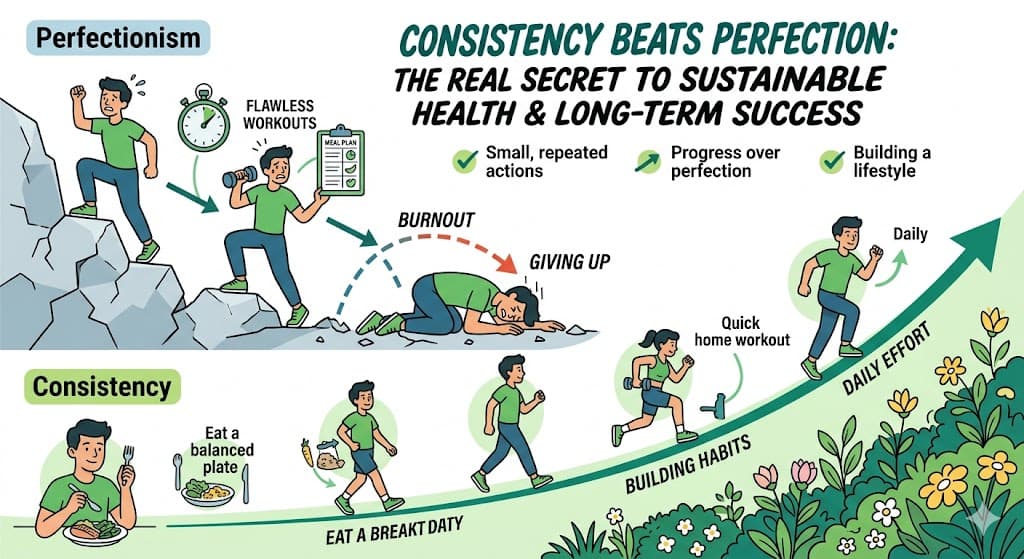
The truth is simple but uncomfortable: perfection is not sustainable. Consistency is.
If you want real results whether it’s fat loss, better health, or improved performance you don’t need a perfect plan. You need a plan you can follow consistently, even on your worst days.
Why Perfection Fails in Real Life
Perfection sounds good in theory, but it collapses under real-world conditions.
Perfect diets require perfect discipline, perfect timing, and perfect circumstances. Life doesn’t work that way. There will always be stress, unexpected events, low-energy days, and moments where motivation disappears.
When your plan leaves no room for flexibility, it becomes fragile. One mistake feels like total failure, and that mindset pushes people to give up completely.
This is where most people go wrong. They treat small deviations as reasons to stop instead of simply adjusting and continuing.
Perfection creates pressure. Consistency removes it.
The Power of Small, Repeated Actions
Your body does not respond to what you do once. It responds to what you do repeatedly.
A single healthy meal doesn’t transform your body, just like one unhealthy meal doesn’t destroy it. What matters is the pattern you follow over time.
When you focus on consistency, you build habits. And habits are what drive long-term results.
Eating balanced meals most of the time, staying active regularly, and maintaining basic discipline creates a steady upward trend. It may not feel dramatic, but it works.
Perfection tries to sprint. Consistency plays the long game.
Consistency and Fat Loss: What Actually Works
Fat loss is often misunderstood because people look for fast results instead of sustainable ones.
Extreme diets can produce quick weight loss, but they are difficult to maintain. As soon as the diet stops, the weight often comes back, sometimes even more than before.
Consistency, on the other hand, creates gradual but lasting results. When you maintain a manageable calorie balance over time, your body adapts without extreme stress.
This approach also protects your metabolism and reduces the chances of rebound weight gain.
Fat loss is not about doing everything perfectly for a short time. It’s about doing the right things often enough for long enough.
The Psychological Advantage of Consistency
Consistency is not just physical it’s mental.
When you aim for perfection, you constantly feel pressure. Every decision feels like a test, and every mistake feels like failure. This creates stress, which makes it harder to stay disciplined.
Consistency removes that burden. It allows flexibility. It accepts that some days will not be perfect, and that’s okay.
This mindset makes it easier to stay on track because you’re not constantly fighting yourself.
Instead of thinking in extremes perfect or failure you start thinking in progress. And progress is what actually leads to results.
Why “All or Nothing” Thinking Is Dangerous
One of the biggest obstacles to consistency is the all-or-nothing mindset.
People believe they must follow their plan perfectly, and if they can’t, they might as well not try at all. This thinking destroys progress.
Missing one workout does not matter. Eating one unhealthy meal does not matter. What matters is what you do next.
Consistency is built by returning to your routine quickly, not by avoiding mistakes completely.
The faster you get back on track, the less impact any mistake has.
Building a Lifestyle Instead of Following a Plan
Temporary plans create temporary results. Sustainable lifestyles create lasting change.
Consistency comes from designing a routine that fits your life, not one that fights against it.
If your diet is too strict, you won’t follow it long-term. If your workout routine is too demanding, you’ll eventually skip it. If your schedule doesn’t match your daily responsibilities, it will fall apart.
A sustainable lifestyle is flexible, realistic, and adaptable.
It allows you to stay consistent even when life is not perfect.
How Consistency Improves Every Area of Health
When consistency becomes your focus, improvements start showing across multiple areas.
Your digestion becomes more stable because your eating pattern is regular. Your energy levels improve because your body receives consistent fuel. Your workouts become more effective because you show up regularly.
Even your mental clarity improves because you’re not constantly stressing about being perfect.
Over time, these small improvements compound into significant results.
This is the power of consistency it builds quietly but delivers strongly.
The Long-Term Advantage of Consistency
Consistency may feel slower in the beginning, but it wins in the long run.
Short-term perfection often leads to burnout. Long-term consistency leads to stability.
When you stay consistent, your progress becomes predictable. You don’t experience extreme highs and lows. Instead, you build a steady path toward your goals.
This approach is not exciting, but it is effective.
And effectiveness is what matters.
Conclusion
Perfection is attractive, but it’s unrealistic. It sets you up for failure because it doesn’t account for real life.
Consistency, on the other hand, works with reality. It allows mistakes, adapts to challenges, and focuses on long-term progress.
If you shift your focus from being perfect to being consistent, everything changes. Your stress reduces, your discipline improves, and your results become sustainable.
You don’t need to be perfect to succeed.
You need to keep showing up.